

By: John Moritz, Environment and Energy Reporter ...“I think the future just looked limitless,” Passero said. “You could almost look to Europe and really see the future here, see everything that can be done. And we have some of the best wind in the world right off the Northeast here, so the industry really looked good there for a while. “Until Donald Trump got reelected,” he said. Before last year’s efforts by the Trump administration to grind America’s offshore wind industry to a halt, New London was poised to become a regional hub for developers looking to take advantage of the Atlantic’s abundant winds. The state of Connecticut, through the use of public borrowing, invested more than $211 million to expand a state-owned pier in the city to handle the loading and offloading of parts onto specialized installation vessels. The Danish energy developer Ørsted, partnering with local utility company Eversource, signed on to launch its first three U.S. offshore wind projects from New London, kicking in another $100 million toward the redevelopment of the State Pier. In addition to employing thousands of workers during construction, the wind projects were billed as a way to wean the region off its historic dependence on oil and natural gas to meet its growing energy needs. Revolution Wind, the second of the three Ørsted projects launched from New London, is contracted to sell 704 megawatts of electricity — enough to power 350,000 homes — to customers in Connecticut and Rhode Island. The other two projects, South Fork and Sunrise Wind, are connected to New York through underwater cables. The resulting uncertainty has led international wind developers to redirect investment towards other countries or even sell back their leases. Workers who have undergone specialized training or pinned their futures on the promise of steady offshore wind construction could find themselves unable to continue working in the industry. Meanwhile, the states that invested heavily in offshore wind infrastructure are at risk of seeing their purpose-built piers sitting empty, as is the case in New Bedford. That initial run of offshore wind projects is only scheduled to last through 2027. Officials are searching for a future tenant that can take over Ørsted’s position at the pier, but no contracts have been announced. As those connections get up and running, much of the work will dry up. If the Trump administration succeeds in its ongoing efforts to end future offshore wind development in the United States — which by recent accounts is likely — it will eliminate thousands of current and future jobs on America’s waterfronts from Massachusetts to Virginia. Many of these jobs are located in struggling seaports like New Bedford, Mass., and New London, Conn., where states invested hundreds of millions of dollars in port infrastructure and workforce training to court giant offshore wind companies. The resulting uncertainty has led international wind developers to redirect investment towards other countries or even sell back their leases. Workers who have undergone specialized training or pinned their futures on the promise of steady offshore wind construction could find themselves unable to continue working in the industry. Meanwhile, the states that invested heavily in offshore wind infrastructure are at risk of seeing their purpose-built piers sitting empty, as is the case in New Bedford. That initial run of offshore wind projects is only scheduled to last through 2027. Officials are searching for a future tenant that can take over Ørsted’s position at the pier, but no contracts have been announced. ....While the current slate of projects is likely to be completed, he said, it would could some time before any new projects are announced. Read the full story online through the CT Mirror.
OP-ED: Offshore wind offered a ‘limitless’ future for CT. Trump scuttled the plan.
In New London, the offshore wind industry promised steady jobs and an economic boost for adjacent businesses
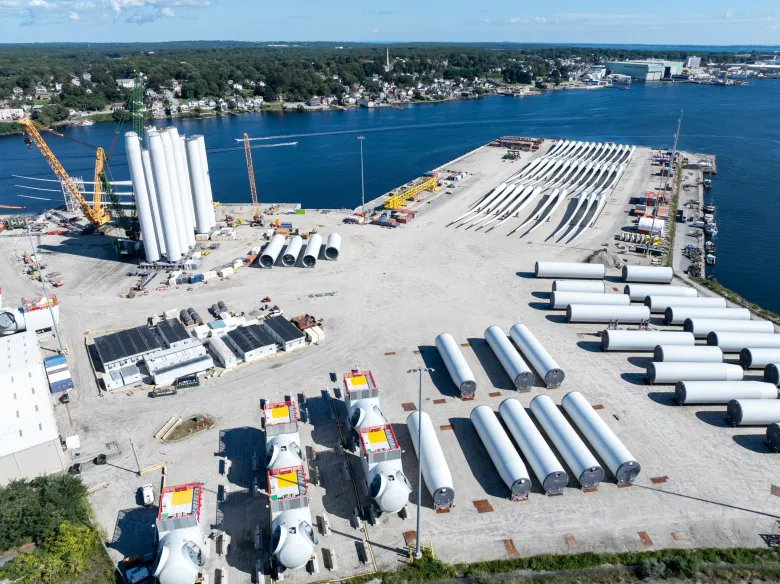 Staging for offshore wind projects at New London State Pier is seen on Fri, Sept.18, 2026. Credit: Sarah Gordon / CT Mirror
Powered By GrowthZone